
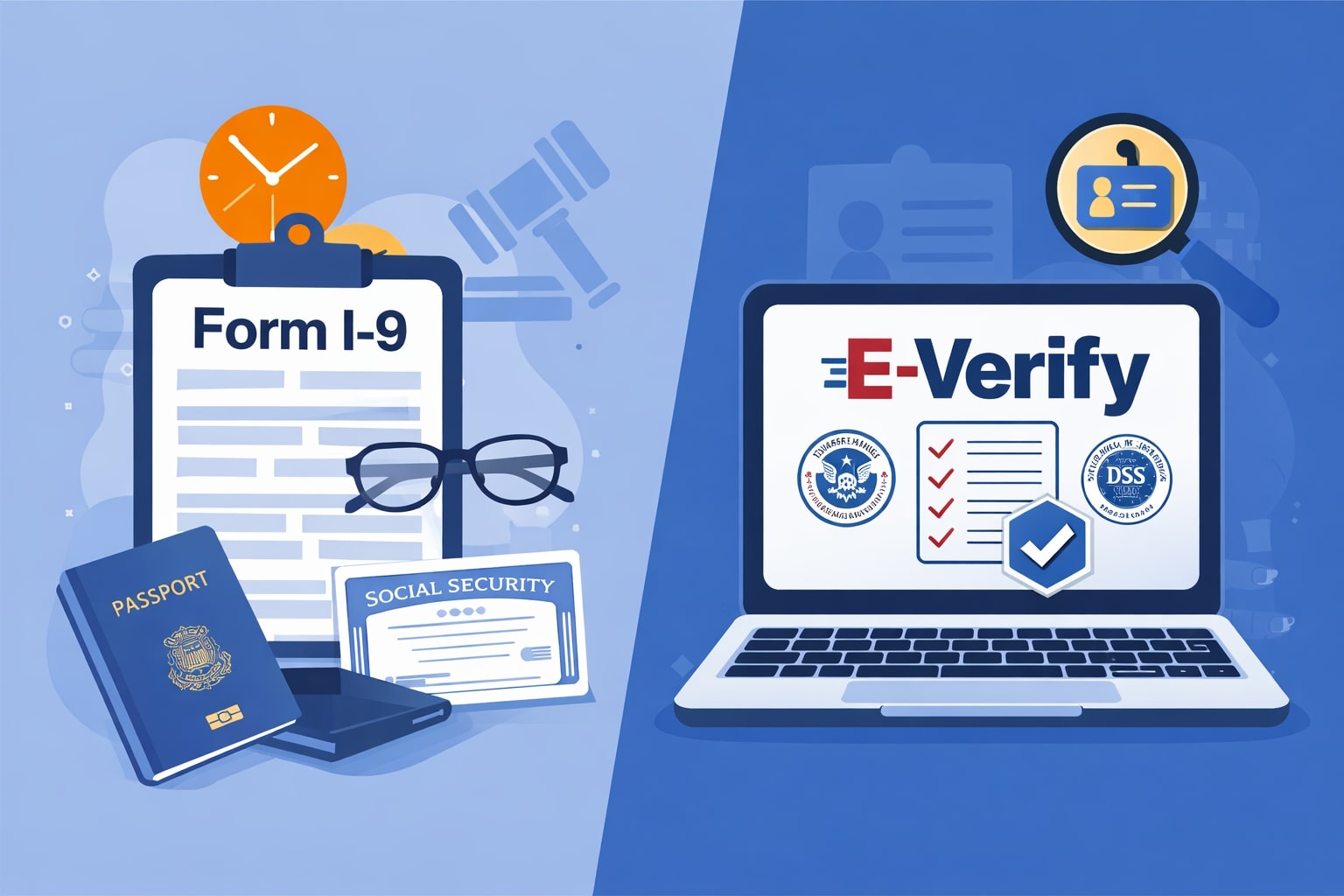
Many employers struggle to understand E-Verify vs Form I-9 requirements. These two systems are closely connected but not interchangeable, and confusing them can expose organizations to costly compliance violations.
While Form I-9 is required for every U.S. employer, E-Verify is only required in specific federal or state-regulated situations. Knowing when Form I-9 alone is sufficient—and when E-Verify must also be used—is essential for reducing risk, passing audits, and hiring confidently.
What Is Form I-9?
Form I-9 is a mandatory federal employment eligibility document issued by U.S. Citizenship and Immigration Services (USCIS). It verifies:
- Employee identity
- Authorization to work in the United States
Form I-9 Timeline Requirements
- Section 1: Completed by the employee on or before the first day of work
- Section 2: Completed by the employer within three business days
- Documents: Original documents from the Lists of Acceptable Documents must be examined (no photocopies)
Who Must Complete Form I-9 Forms?
Every U.S. employer must complete Form I-9 for every employee, regardless of:
- Company size
- Industry
- Citizenship status
This includes full-time, part-time, temporary, and short-term employees.
Common Form I-9 Requirements (and Penalties)
To remain compliant, employers must:
- Use the current version of Form I-9
- Follow strict completion timelines
- Examine original documents
- Retain forms for three years after hire or one year after termination (whichever is later)
Penalties for Form I-9 Violations
- Paperwork errors: $281–$2,789 per form
- Knowingly hiring unauthorized workers: up to $27,894 per violation
Translation: even “small” errors add up fast.
What Is E-Verify?
E-Verify is an electronic employment verification system operated by the Department of Homeland Security (DHS) in partnership with the Social Security Administration (SSA).
Unlike Form I-9, E-Verify is not required for all employers.
E-Verify compares information from a completed Form I-9 against government databases and typically returns an “Employment Authorized” result within seconds.
Who Is Required to Use E-Verify?
E-Verify requirements depend on employer circumstances.
Federal Contractors
Employers with qualifying federal contracts must use E-Verify under the Federal Acquisition Regulation (FAR) E-Verify clause.
State-Mandated Employers
Some states require E-Verify for:
- Public employers
- Private employers above certain size thresholds
- Specific industries
States with E-Verify requirements include Alabama, Arizona, Florida, Georgia, Louisiana, Mississippi, North Carolina, South Carolina, Tennessee, Texas, Utah, and Virginia.
Voluntary E-Verify Participation
Employers not legally required to use E-Verify may still enroll voluntarily.
Benefits include:
- Added verification layer
- Stronger compliance documentation
- Reduced risk during audits
⚠️ Important: Once enrolled, E-Verify must be used for all new hires. Selective use is prohibited.
E-Verify vs Form I-9: Key Differences
Mandatory vs Optional
- Form I-9: Required for every employer
- E-Verify: Required only in specific situations
Timing
- Form I-9: Completed on day one and within three business days
- E-Verify: Case must be created within three business days of hire
Process
- Form I-9: Document review (physical or authorized remote)
- E-Verify: Electronic submission using I-9 data
Government Interaction
- Form I-9: Stored internally, produced during audits
- E-Verify: Real-time interaction with DHS and SSA
Results
- Form I-9: Document-based verification
- E-Verify: Case results such as Employment Authorized or Tentative Non-Confirmation (TNC) requiring follow-up actions
When You Need Both E-Verify and Form I-9
Most situations that require E-Verify also require Form I-9—never one without the other.
You Need Both If You Are:
- A federal contractor with a FAR E-Verify clause
- Operating in a state with E-Verify laws
- A voluntary E-Verify participant
Common Misconceptions About E-Verify vs Form I-9
❌ E-Verify replaces Form I-9
✅ False. E-Verify never replaces Form I-9.
❌ E-Verify is mandatory for all employers
✅ False. Only specific employers are required.
❌ E-Verify can be used before hiring
✅ False. It may only be used after a job offer is accepted.
❌ Form I-9 compliance is low risk
✅ False. Even technical errors can trigger significant fines.
How EvoCon Simplifies Form I-9 and E-Verify Compliance
Managing Form I-9 and E-Verify internally strains HR teams and increases error risk. Evolution Consulting acts as a Designated E-Verify Agent, managing the entire process end to end.
Our Compliance Process
- Secure submission through our portal
- Candidate data collection
- Section 1 completion assistance
- Authorized remote document examination
- E-Verify case submission and tracking
Each completed case includes:
- Finalized Form I-9
- Document copies
- E-Verify case report
Why Outsource to a Designated Agent?
- Reduced compliance risk
- No internal training burden
- Audit-ready documentation
- Continuous regulatory monitoring
Best Practices for Form I-9 and E-Verify Compliance
- Document clear internal procedures
- Always use current forms
- Store documentation securely
- Conduct regular internal audits
- Apply requirements uniformly to avoid discrimination claims
- Handle Tentative Non-Confirmations promptly
The Cost of Non-Compliance
- Form I-9 fines: $281–$2,789 per form
- E-Verify violations: contract termination, fines, or license loss
- Indirect costs: legal fees, disruptions, reputational damage
Compliance mistakes rarely stay small.
Staying Compliant in 2026 and Beyond
Regulations evolve. Employers should:
- Monitor policy updates
- Invest in training
- Partner with compliance professionals
Preparation today prevents audits tomorrow.
Frequently Asked Questions
Do remote employees need Form I-9?
Yes. All employees must complete Form I-9. Remote inspection is permitted under specific USCIS rules and requires E-Verify participation.
Can E-Verify be used without Form I-9?
No. E-Verify requires information from a completed Form I-9.
How long must I keep I-9 forms?
Three years after hire or one year after employment ends—whichever is later.
Ready to Simplify Your Form I-9 and E-Verify Compliance?
Contact Evolution Consulting today.
As a Designated E-Verify Agent, we manage the entire process and help protect your organization from costly compliance mistakes.Call: (607) 773-2266
Email: contact@evoconbgc.com
Or just use our form to contact us here